
Whether you’re planning to build a tennis court for a school, sports academy, club, residential community, or recreational facility, understanding the correct tennis court dimensions is essential. Accurate measurements ensure fair play, player safety, and compliance with international standards. A professionally designed court also improves the overall playing experience and increases the lifespan of the sports facility.
In this guide, you’ll learn what are the dimensions of a tennis court, including tennis court dimensions in meters, tennis court dimensions in feet, court markings, net height, service boxes, and the difference between a lawn tennis court and table tennis court dimensions. This information is useful for architects, sports consultants, schools, colleges, developers, and anyone planning a new sports facility.
Also Read: Sports Infrastructure Development
What Are the Official Tennis Court Dimensions?
The International Tennis Federation (ITF) specifies the standard dimensions for a tennis court used in professional and recreational matches.
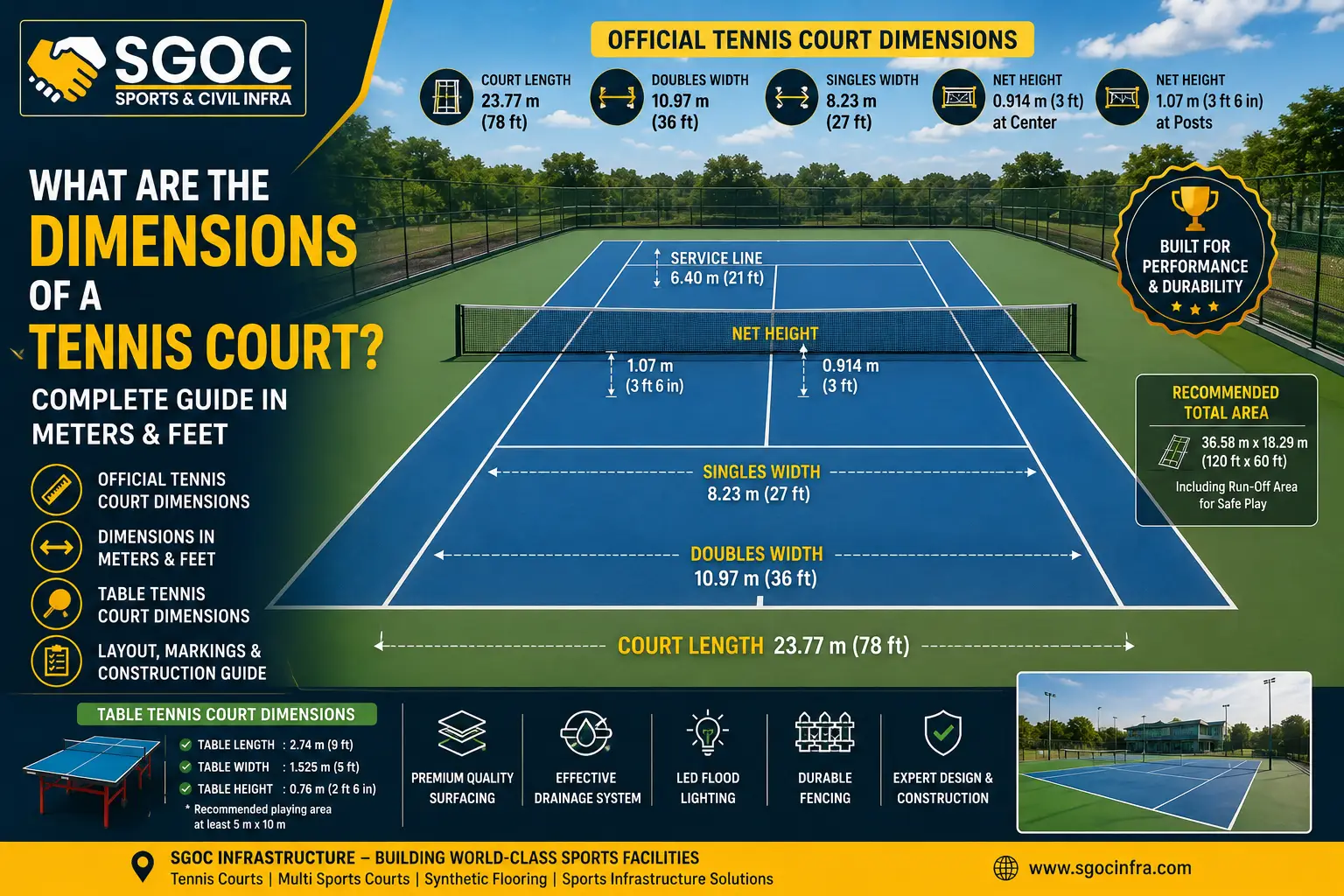
The official court measurements are:
| Measurement | In Meters | In Feet |
|---|---|---|
| Court Length | 23.77 m | 78 ft |
| Doubles Court Width | 10.97 m | 36 ft |
| Singles Court Width | 8.23 m | 27 ft |
| Net Height (Center) | 0.914 m | 3 ft |
| Net Height (Posts) | 1.07 m | 3 ft 6 in |
| Service Line Distance from Net | 6.40 m | 21 ft |
These dimensions are universally used in international tournaments, schools, clubs, and residential sports facilities.
Tennis Court Dimensions in Meters
Many construction professionals and sports infrastructure companies use the metric system during planning and installation.
The official tennis court dimensions in meters are:
- Length: 23.77 meters
- Singles Width: 8.23 meters
- Doubles Width: 10.97 meters
- Distance from Net to Service Line: 6.40 meters
- Net Height at Center: 0.914 meters
- Net Height at Posts: 1.07 meters
When designing a tennis court, additional clearance around the playing area should also be considered to provide players with enough space to move comfortably during matches.
For recreational courts, a total playing area of approximately 36.6 meters × 18.3 meters is generally recommended, including safety run-off zones.
Tennis Court Dimensions in Feet
If you’re working with imperial measurements, the standard tennis court dimensions in feet are:
- Length: 78 feet
- Singles Width: 27 feet
- Doubles Width: 36 feet
- Service Line: 21 feet from the net
- Net Height at Center: 3 feet
- Net Height at Posts: 3 feet 6 inches
These measurements are commonly used in countries that follow the imperial system and are equally important when planning professional or community sports facilities.
Understanding Tennis Court Layout
A tennis court consists of several important sections, each serving a specific purpose during play.
Baseline
The baseline is located at both ends of the court and marks the back boundary. Players usually serve from behind this line.
Service Line
The service line is positioned 21 feet (6.40 meters) from the net on each side. It helps create the service boxes where serves must land.
Center Service Line
This line divides each service area into two equal service boxes, allowing players to serve diagonally across the court.
Singles Sidelines
The inner sidelines define the playing area for singles matches.
Doubles Sidelines
The outer sidelines expand the court width for doubles matches.
Center Mark
A short line in the middle of each baseline helps players position themselves correctly while serving.
Tennis Court Surface Options
Selecting the right surface is just as important as following the correct dimensions. Different surfaces affect ball speed, bounce, maintenance requirements, and player comfort.
Acrylic Hard Courts
Hard courts are among the most popular choices for schools, clubs, and residential projects. They require minimal maintenance, provide consistent ball bounce, and are suitable for year-round use.
Synthetic Courts
Synthetic sports flooring offers excellent durability and shock absorption. It is commonly used for multi-sports facilities and professional tennis courts.
Clay Courts
Clay courts slow down the game and produce a higher ball bounce. They require regular watering and maintenance but are preferred for training and competitive tournaments.
Natural Grass Courts
Grass courts provide a fast-paced game but demand extensive maintenance, irrigation, and seasonal care.
Why Accurate Tennis Court Dimensions Matter
Following official tennis court measurements offers several benefits:
- Ensures compliance with international playing standards.
- Provides a consistent playing experience for athletes.
- Reduces the risk of construction errors.
- Improves player safety.
- Supports future tournament approvals.
- Enhances the value and usability of sports facilities.
Whether you’re building a tennis court for a school, university, sports academy, housing society, or commercial sports complex, precise dimensions are essential for long-term performance.
Difference Between Tennis Court and Table Tennis Court Dimensions
Many people confuse lawn tennis courts with table tennis playing areas. However, they are entirely different sports with different equipment and playing surfaces.
A standard lawn tennis court measures 23.77 meters (78 feet) in length and 10.97 meters (36 feet) in width for doubles matches.
In contrast, a table tennis table measures only 2.74 meters long, 1.525 meters wide, and 0.76 meters high. While people often search for table tennis court dimensions, the official measurements actually refer to the dimensions of the table itself. For comfortable play, a larger surrounding area is recommended around the table, especially for competitive matches.
Recommended Total Area for Tennis Court Construction
While the official playing court measures 23.77 m × 10.97 m (78 ft × 36 ft) for doubles, additional space is essential to ensure player safety and comfortable movement during matches.
A recommended total area for a standard tennis court is:
| Area | Dimensions (Approx.) |
|---|---|
| Total Length | 36.58 meters (120 feet) |
| Total Width | 18.29 meters (60 feet) |
These extra run-off areas allow players to chase the ball safely without colliding with fences or surrounding structures. Sports clubs, schools, and professional facilities should always consider these clearances during the planning stage.
Tennis Court Construction Tips
Building a high-quality tennis court involves more than following the correct dimensions. Proper planning and quality materials significantly impact the court’s durability and performance.
1. Select the Right Location
Choose a level site with good drainage to prevent water accumulation. Proper site preparation minimizes maintenance issues in the future.
2. Use Quality Base Materials
A strong foundation ensures the court remains level and crack-free for years. High-quality sub-base materials improve structural stability.
3. Choose the Right Surface
The playing surface should match the intended use. Acrylic hard courts are ideal for schools and residential communities, while synthetic flooring is suitable for multi-sports facilities.
4. Install Proper Lighting
LED sports lighting improves visibility during evening matches while reducing energy consumption.
5. Add Perimeter Fencing
A durable fence keeps the ball within the playing area and enhances player safety.
6. Plan Effective Drainage
An efficient drainage system protects the court surface from water damage and extends its lifespan.
Common Mistakes to Avoid
Many tennis court projects face unnecessary delays or increased costs because of poor planning. Avoid these common mistakes:
- Using incorrect court measurements.
- Ignoring safety run-off areas.
- Selecting low-quality flooring materials.
- Installing inadequate drainage systems.
- Choosing improper lighting placement.
- Neglecting regular maintenance.
Working with an experienced sports infrastructure company helps ensure the court meets international standards while delivering long-term value.
Who Can Benefit from a Professional Tennis Court?
A professionally constructed tennis court is a valuable investment for many organizations, including:
- Schools and educational institutions
- Colleges and universities
- Sports academies
- Residential communities
- Clubs and fitness centers
- Government sports complexes
- Corporate campuses
- Hotels and resorts
A well-designed court encourages sports participation, supports athlete development, and increases the overall appeal of the facility.
Why Choose SGOC Infrastructure for Tennis Court Construction?
Designing and constructing a tennis court requires technical expertise, precision, and high-quality materials. SGOC Infrastructure specializes in developing sports infrastructure that meets professional standards while delivering durability and excellent playing performance.
From site assessment and planning to surface installation, fencing, lighting, and final court markings, the team provides end-to-end solutions tailored to schools, sports academies, clubs, residential communities, and commercial sports projects. Every project is completed with attention to quality, safety, and long-term performance.
Whether you’re planning a recreational court or a tournament-ready facility, partnering with experienced professionals helps ensure your investment delivers lasting value.
Frequently Asked Questions (FAQs)
1. What are the dimensions of a tennis court?
A standard tennis court measures 23.77 meters (78 feet) long. The width is 8.23 meters (27 feet) for singles and 10.97 meters (36 feet) for doubles.
2. What are tennis court dimensions in meters?
The official dimensions are 23.77 m long, 8.23 m wide for singles, and 10.97 m wide for doubles.
3. What are tennis court dimensions in feet?
A tennis court is 78 feet long, 27 feet wide for singles, and 36 feet wide for doubles.
4. How high is a tennis net?
The net height is 0.914 meters (3 feet) at the center and 1.07 meters (3 feet 6 inches) at the posts.
5. What are table tennis court dimensions?
A standard table tennis table measures 2.74 meters long, 1.525 meters wide, and 0.76 meters high. For tournaments, a larger playing area around the table is recommended.
6. How much space is needed to build a tennis court?
Including safety run-off areas, the recommended overall space is approximately 36.58 meters × 18.29 meters (120 ft × 60 ft).
Conclusion
Understanding what are the dimensions of a tennis court is the first step toward building a safe, durable, and professional sports facility. Whether you’re planning a tennis court for a school, sports academy, residential community, or commercial project, following official dimensions ensures a better playing experience and compliance with international standards.
From tennis court dimensions in meters and tennis court dimensions in feet to understanding the difference between lawn tennis and table tennis court dimensions, accurate planning plays a vital role in the success of any project.
If you’re looking for expert sports infrastructure solutions, SGOC Infrastructure offers complete tennis court design and construction services, delivering high-quality facilities that combine performance, durability, and long-term value.