
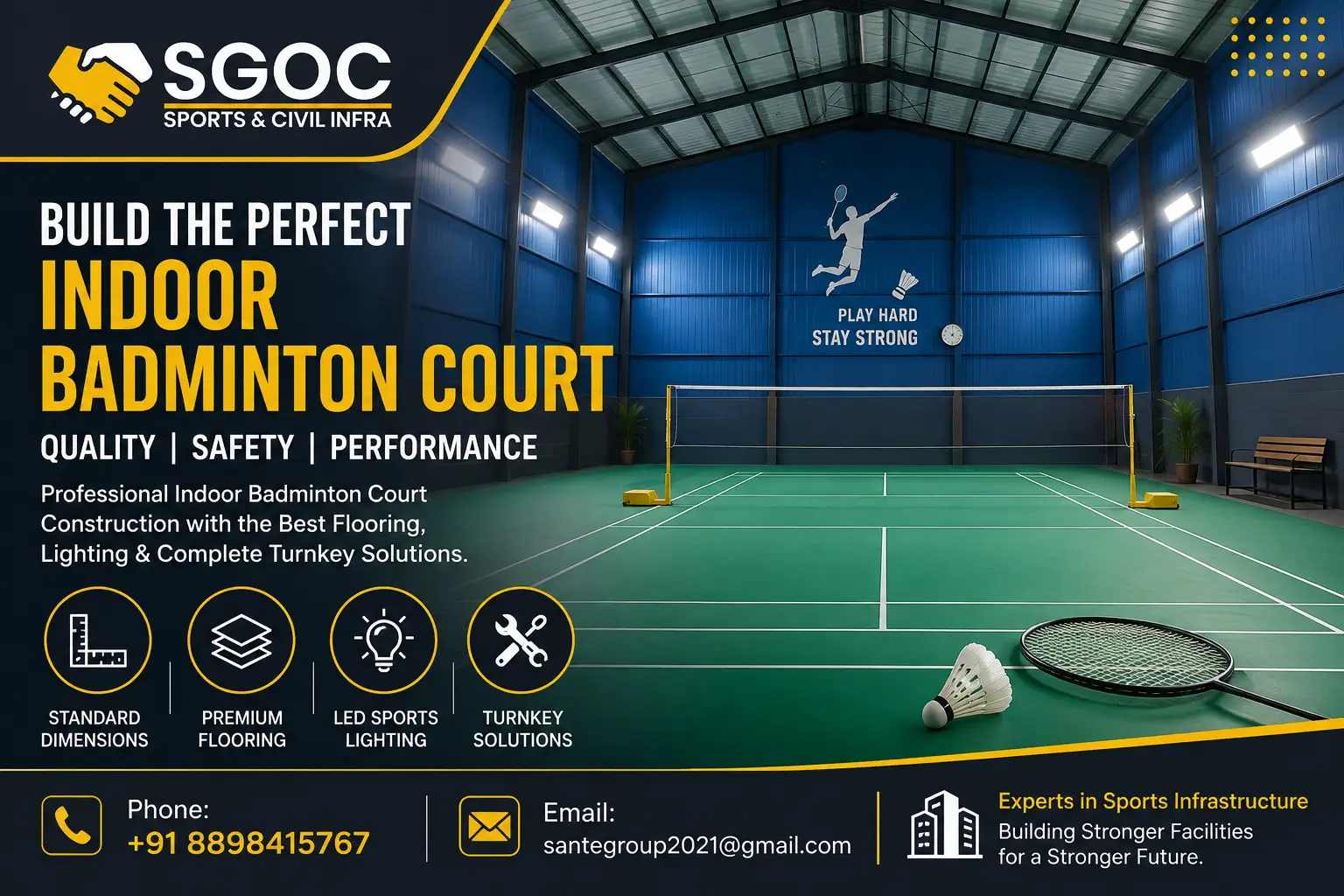
Badminton is one of the fastest-growing indoor sports in India, with increasing participation in schools, colleges, sports academies, fitness clubs, residential communities, and professional training centres. As demand grows, many organisations are looking to build professional indoor badminton courts that provide safe playing conditions and a comfortable environment for players.
But how do you build an indoor badminton court in India? What space is required? Which flooring is best? How much does construction cost? What type of lighting should be installed?
This complete guide explains the key requirements, construction process, flooring options, cost factors, and maintenance considerations for an indoor badminton court.
Also Read: Multi Sport Court Design, Dimensions & Construction Guide
What Is an Indoor Badminton Court?
An indoor badminton court is a purpose-built or converted indoor sports facility designed specifically for badminton. Unlike an outdoor court, an indoor facility provides protection from rain, direct sunlight, wind, and other weather conditions.
A professional indoor badminton facility generally includes:
- Badminton playing courts
- Sports flooring
- Adequate ceiling height
- Professional lighting
- Proper ventilation
- Court line markings
- Safety clearance around the court
- Net posts and badminton nets
- Wall protection where required
- Changing or spectator areas where applicable
The design should focus on player safety, visibility, comfort, and consistent playing conditions.
What Are the Standard Badminton Court Dimensions?
A standard badminton court has a playing area of approximately 13.4 metres in length and 6.1 metres in width for doubles play. Singles play uses the same court length but a narrower playing width.
However, the playing lines are only one part of the planning process.
Additional space is required around the court so players can move safely during rallies. Therefore, the total facility footprint should be larger than the marked playing area.
If multiple courts are planned, sufficient spacing between courts and appropriate circulation areas should also be considered.
Also Read: Pickleball Court Construction in Mumbai
How Much Space Is Required for an Indoor Badminton Court?
The exact space requirement depends on the number of courts, available building structure, spectator requirements, circulation, storage, and other facilities.
Before construction, consider:
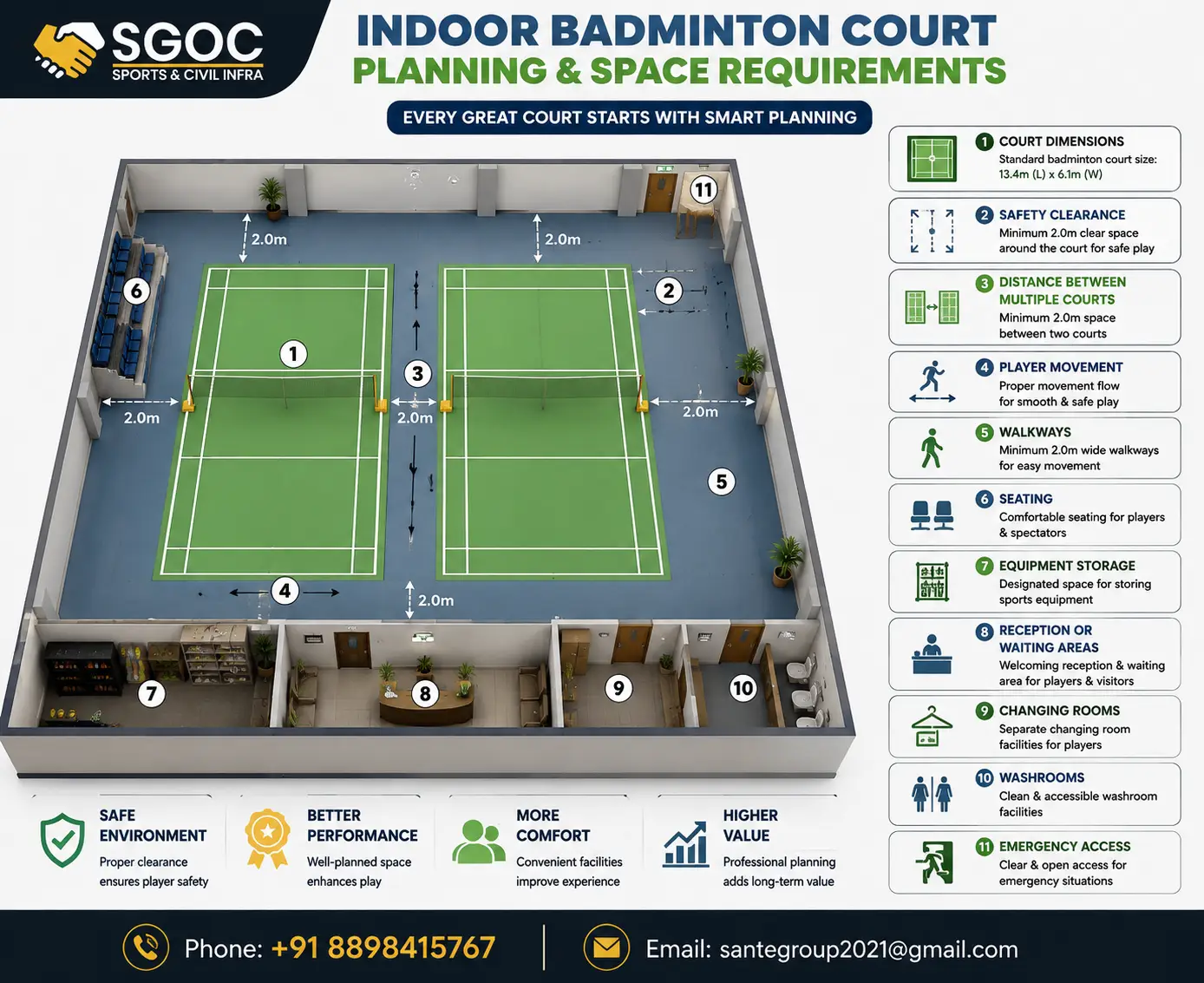
A professional site assessment can help determine whether an existing hall or building is suitable for badminton court development.
What Ceiling Height Is Required for an Indoor Badminton Court?
Ceiling height is one of the most important considerations when developing an indoor badminton facility.
Badminton involves high clears and powerful shots that can travel significantly upward. A low ceiling can interfere with gameplay and reduce the quality of the facility.
The building should therefore provide adequate clear height above the playing area, without beams, fans, lights, ducts, or other obstacles interfering with the flight of the shuttle.
The exact requirement should be evaluated according to the intended level of play and the project’s applicable specifications.
Which Flooring Is Best for an Indoor Badminton Court?
Flooring plays a major role in player comfort, movement, grip, and injury prevention.
Common sports flooring options include:
Wooden Sports Flooring
Wooden flooring is widely used for professional indoor sports facilities. A properly designed sports wood flooring system can provide suitable shock absorption and playing characteristics.
PVC or Vinyl Sports Flooring
Sports vinyl systems are another option for indoor badminton facilities. They can offer a practical and relatively easy-to-maintain playing surface when installed over a suitable base.
Synthetic Sports Flooring
Specialised synthetic flooring systems can also be considered depending on the facility’s requirements, usage level, and budget.
The best flooring should not be selected based only on price. Factors such as shock absorption, slip resistance, durability, maintenance, subfloor condition, and expected usage should be considered.
What Type of Lighting Is Required for an Indoor Badminton Court?
Lighting has a direct impact on visibility and player performance.
Badminton players need to track a fast-moving shuttle against the ceiling and background. Poor lighting, glare, shadows, or uneven illumination can make this difficult.
A professional lighting design should consider:
- Uniform illumination
- Glare control
- Light positioning
- Ceiling height
- Court layout
- Player visibility
- Energy efficiency
- Maintenance accessibility
LED sports lighting is commonly considered for modern indoor facilities because it can provide efficient illumination when appropriately designed and installed.
Lights should be positioned carefully so that players are not looking directly into bright fixtures while tracking the shuttle.
Why Is Ventilation Important in an Indoor Badminton Facility?
Indoor badminton facilities can become warm and humid because of continuous player activity.
Good ventilation and air management can improve player comfort and help maintain a better indoor environment.
However, airflow should be carefully controlled. Excessive air movement across the court can affect the flight of the shuttle and interfere with gameplay.
Therefore, ventilation design should balance:
Player comfort + temperature control + air quality + stable playing conditions.
What Is the Process of Indoor Badminton Court Construction?
A professional badminton court project generally involves several stages.
1. Site Inspection
The first step is to evaluate the available building or land.
The inspection may consider:
- Available dimensions
- Existing flooring
- Ceiling height
- Structural condition
- Moisture
- Ventilation
- Electrical requirements
- Accessibility
2. Design and Layout
The facility layout is prepared according to the number of courts and supporting requirements.
3. Base Preparation
The existing floor may need repair, levelling, moisture treatment, or other preparation before sports flooring is installed.
4. Sports Flooring Installation
The selected flooring system is installed according to the manufacturer’s and project’s requirements.
5. Lighting Installation
Sports lighting is installed and positioned to provide suitable illumination across the playing area.
6. Court Marking
Accurate line marking is completed according to the badminton court layout.
7. Equipment Installation
Nets, posts, protective systems, seating, storage solutions, and other accessories can be installed as required.
8. Final Inspection
The completed facility should be inspected for flooring quality, lighting, markings, safety, and overall functionality before opening.
How Much Does It Cost to Build an Indoor Badminton Court in India?
There is no fixed cost for indoor badminton court construction in India because the total investment depends on the project specifications.
Major cost factors include:
- Number of courts
- Existing building versus new construction
- Civil work
- Flooring system
- Ceiling requirements
- Lighting
- Electrical work
- Ventilation
- Court equipment
- Wall protection
- Seating
- Changing rooms
- Location
- Interior finishing
- Installation and labour
For example, converting an existing suitable hall may have a different cost structure from constructing a completely new indoor sports building.
The best way to determine the actual investment is to conduct a site assessment and prepare a project-specific quotation.
Can an Existing Hall Be Converted into a Badminton Court?
Yes, an existing hall can potentially be converted into an indoor badminton facility if it meets the required space, height, structural, flooring, lighting, and ventilation conditions.
Before starting conversion work, inspect:
- Ceiling height
- Roof condition
- Floor level
- Moisture
- Structural stability
- Available court area
- Lighting positions
- Electrical capacity
- Ventilation
- Emergency exits
Converting a suitable existing structure can sometimes be more practical than constructing a completely new facility, but the feasibility depends on the site.
How to Maintain an Indoor Badminton Court?
Regular maintenance can help protect the playing surface and extend the facility’s useful life.
A maintenance plan may include:
- Regular floor cleaning
- Immediate removal of spills
- Inspection of flooring
- Checking court lines
- Net and post inspection
- Lighting checks
- Ventilation system maintenance
- Moisture monitoring where required
- Periodic professional inspection
Players should also follow appropriate footwear and facility-use guidelines to reduce unnecessary wear.
How to Choose an Indoor Badminton Court Construction Company?
Selecting the right construction partner can significantly affect the quality and long-term performance of the facility.
Before hiring a company, check:
- Relevant experience – Review previous badminton and indoor sports projects.
- Complete project capability – Ask whether the company can manage flooring, lighting, civil work, equipment, and other requirements.
- Material quality – Understand the proposed flooring and construction systems.
- Project scope – Ensure the quotation clearly explains inclusions and exclusions.
- Timeline – Request a realistic project schedule.
- Maintenance support – Ask about post-installation services.
- Previous work – Review completed facilities where possible.
A company that understands the complete sports infrastructure process can help reduce coordination problems between multiple vendors.
Why Choose SGOC Infrastructure for Indoor Sports Facilities?
SGOC Infrastructure provides sports infrastructure solutions for organisations looking to develop professional sports facilities in India.
The company offers turnkey sports infrastructure services covering areas such as badminton, tennis, pickleball, football, and cricket facilities, with solutions involving design, flooring, lighting, and maintenance.
For an indoor badminton project, SGOC Infra can help clients evaluate their requirements and develop a solution based on available space, intended usage, design requirements, flooring preferences, lighting, and overall project objectives.
The focus should be on developing a facility that is safe, functional, durable, visually appealing, and suitable for its intended users.
Also Read: Sports Equipment Suppliers in India
Frequently Asked Questions
What is the standard size of a badminton court?
A standard doubles badminton court measures approximately 13.4 metres long and 6.1 metres wide. Additional space is required around the court for player safety and movement.
What flooring is best for indoor badminton?
Wooden sports flooring, sports vinyl, and specialised synthetic systems can all be considered. The right option depends on shock absorption, grip, durability, maintenance, budget, and facility requirements.
How much does an indoor badminton court cost in India?
The cost varies according to the number of courts, building condition, flooring, lighting, civil work, ventilation, equipment, and other requirements. A site-specific quotation provides a more accurate estimate.
Can a school or college convert an existing hall into a badminton court?
Yes, an existing hall may be converted if it has sufficient dimensions, clear height, structural suitability, appropriate flooring conditions, lighting possibilities, and ventilation.
Why is ceiling height important for badminton?
Badminton involves high shuttle trajectories. Adequate clear height helps prevent interference with the shuttle and provides a better playing environment.
How long does indoor badminton court construction take?
The timeline depends on whether the project involves a new building or conversion of an existing hall, as well as the number of courts, civil work, flooring, lighting, and other installations.
Must Read: Indoor & Outdoor Basketball Court Construction Guide
Conclusion
Building an indoor badminton court requires careful planning rather than simply marking lines and installing a net. Court dimensions, safety clearance, ceiling height, flooring, lighting, ventilation, drainage or moisture control, equipment, and maintenance all contribute to the quality of the finished facility.
Whether you are planning a badminton court for a school, college, sports academy, residential society, fitness centre, club, or commercial sports facility, working with an experienced sports infrastructure company can help you make better decisions from design through completion.
If you are planning an indoor badminton facility in India, SGOC Infrastructure can help you develop a project based on your space, requirements, budget, and intended usage.