
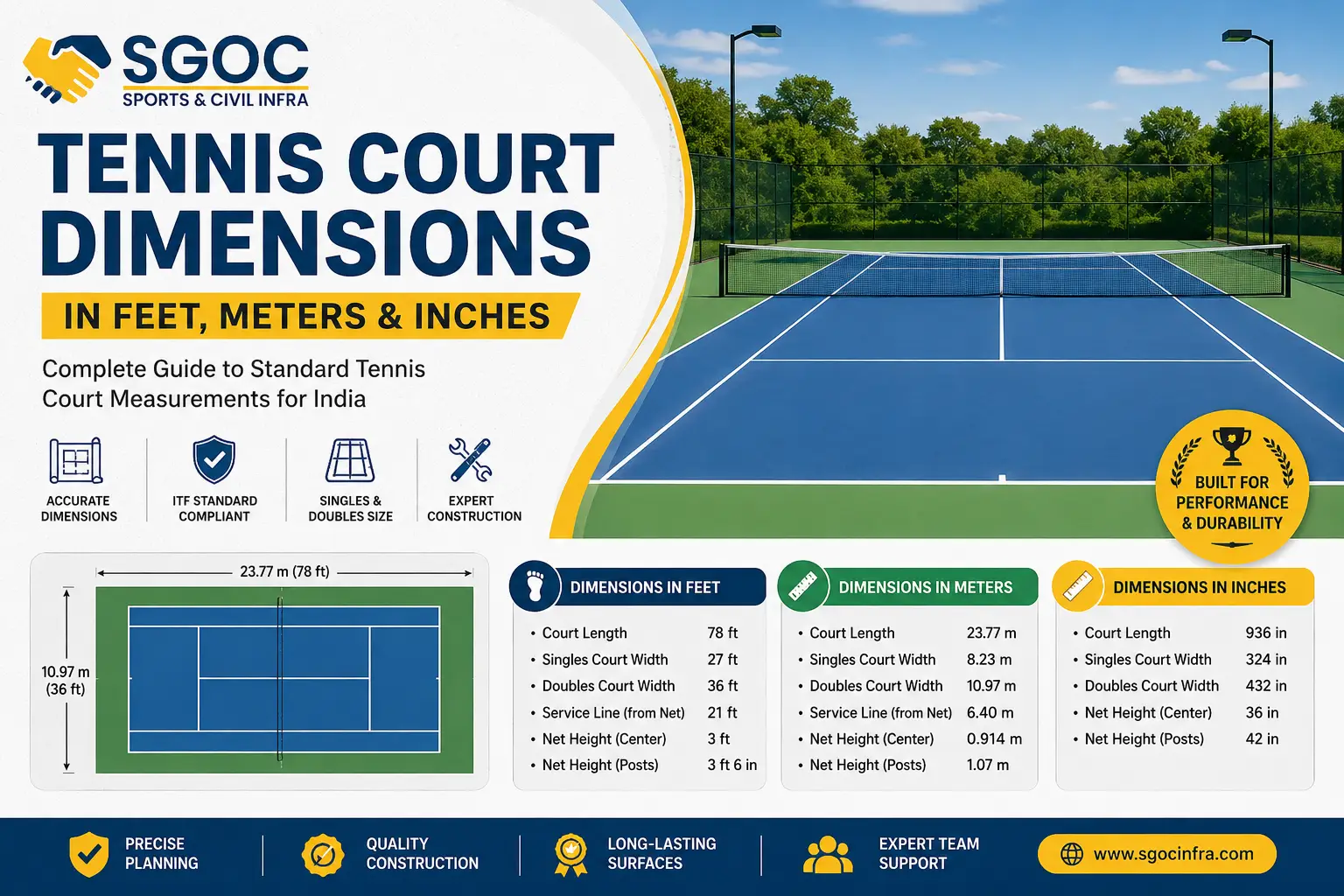
A well-designed tennis court starts with accurate planning and precise measurements. Whether you are building a tennis court for a school, sports academy, residential society, club, university, or commercial sports complex, understanding the official tennis court dimensions is essential. Incorrect dimensions can affect gameplay, player safety, and tournament compliance. That’s why professional sports infrastructure companies follow international standards while adapting designs to local site conditions. In this guide, you’ll learn everything about tennis court dimensions, including standard sizes in feet, meters, and inches, the differences between singles and doubles courts, and key construction considerations for projects in India.
Standard Tennis Court Dimensions
The official dimensions of a tennis court are defined by the International Tennis Federation (ITF). These standards are used worldwide for recreational, training, and professional tennis courts.
| Measurement | Meters | Feet |
|---|---|---|
| Court Length | 23.77 m | 78 ft |
| Singles Court Width | 8.23 m | 27 ft |
| Doubles Court Width | 10.97 m | 36 ft |
| Service Line Distance from Net | 6.40 m | 21 ft |
| Net Height at Centre | 0.914 m | 3 ft |
| Net Height at Posts | 1.07 m | 3 ft 6 in |
Following these dimensions ensures fair play and compliance with international tennis standards.
Tennis Court Dimensions in Feet
Many architects, contractors, and sports facility developers in India still work with imperial measurements during planning. Below are the standard tennis court dimensions in feet.
Court Length
- 78 feet
Singles Court Width
- 27 feet
Doubles Court Width
- 36 feet
Service Line
- 21 feet from the net
Distance Between Singles and Doubles Sidelines
- 4.5 feet on each side
Net Height
- Centre: 3 feet
- Posts: 3 feet 6 inches
These measurements create the playing area used for professional and recreational tennis.
Tennis Court Dimensions in Meters
Most engineering drawings and construction projects in India use metric units. The official measurements are:
- Court Length – 23.77 meters
- Singles Width – 8.23 meters
- Doubles Width – 10.97 meters
- Service Line – 6.40 meters
- Centre Service Line – Runs from the service line to the net
- Net Height at Centre – 0.914 meters
- Net Height at Posts – 1.07 meters
Using metric measurements during construction helps maintain precision and simplifies site execution.
Tennis Court Measurements in Inches
Certain components, such as net height, court markings, and installation details, require measurements in inches.
| Measurement | Inches |
| Court Length | 936 inches |
| Singles Width | 324 inches |
| Doubles Width | 432 inches |
| Net Height at Centre | 36 inches |
| Net Height at Posts | 42 inches |
Although full-court layouts are usually measured in feet or meters, inches are useful for accurate finishing work.
Singles vs Doubles Tennis Court Dimensions
The main difference between singles and doubles tennis courts is the width of the playing area.
Singles Court
- Width: 8.23 meters (27 feet)
- Used for one-on-one matches
- Narrower sidelines
Doubles Court
- Width: 10.97 meters (36 feet)
- Used for team matches
- Includes doubles alleys on both sides
The overall court length remains the same for both formats. Only the width changes.
Space Required Around a Tennis Court
Apart from the playing area, sufficient surrounding space is essential for player movement, safety, and maintenance.
A standard tennis facility should include:
- Side clearance: 3.66 to 4 meters
- Back clearance: 6.40 to 6.70 meters
- Fencing around the court
- Proper lighting for evening matches
- Adequate drainage system
- Spectator and maintenance access
Planning these additional spaces improves the overall playing experience and supports long-term durability of the facility.
Why Accurate Tennis Court Dimensions Matter
Building a tennis court with the correct dimensions offers several advantages:
- Ensures compliance with international standards
- Enhances player safety
- Improves match quality and consistency
- Supports coaching and tournament preparation
- Reduces construction errors and costly modifications
- Increases the long-term value of the sports facility
Whether the court is intended for schools, sports clubs, residential communities, or professional academies, accurate dimensions form the foundation of a successful project.
Tennis Court Construction Standards in India
Building a tennis court involves much more than marking the playing area. The quality of the base, surface material, drainage system, fencing, and lighting all contribute to the court’s performance and durability. In India, weather conditions such as intense heat, monsoon rains, and varying soil types should be considered during the planning stage.
Professional sports infrastructure companies conduct a detailed site survey before construction begins. This helps determine the soil condition, slope, water drainage requirements, and the most suitable court surface for the location.
Popular Tennis Court Surfaces
The choice of surface depends on the intended use, budget, and maintenance requirements.
Acrylic Tennis Courts
Acrylic courts are among the most popular choices for schools, sports clubs, and residential communities. They offer:
- Consistent ball bounce
- Slip-resistant playing surface
- Low maintenance
- Excellent durability
- Suitable for Indian weather conditions
Synthetic Tennis Courts
Synthetic surfaces provide enhanced comfort and reduce stress on players’ joints. These courts are commonly used in sports academies and training centres.
Clay Tennis Courts
Clay courts offer slower ball speed and higher bounce. Although they are preferred by some professional players, they require regular maintenance and are less common in India.
Grass Tennis Courts
Grass courts provide a premium playing experience but demand continuous watering, mowing, and maintenance. They are generally used in prestigious clubs and tournament venues.
Key Factors to Consider Before Building a Tennis Court
A successful tennis court project begins with proper planning. Consider the following factors before starting construction:
- Available land area
- Ground preparation and soil quality
- Court orientation to minimise sun glare
- Drainage system for monsoon protection
- Surface material selection
- High-quality fencing and gates
- LED sports lighting for evening play
- Seating area and player amenities
- Long-term maintenance requirements
Working with an experienced sports infrastructure company helps ensure that every stage of the project meets industry standards and delivers long-lasting performance.
Tennis Court Dimensions for Schools and Sports Academies
Educational institutions are increasingly investing in modern sports facilities to encourage student participation in physical activities. A professionally designed tennis court offers students the opportunity to learn the game while supporting competitive tournaments and training programmes.
Sports academies also require courts built to official dimensions so that players can practise in conditions similar to professional competitions. Accurate court measurements improve skill development and prepare athletes for district, state, and national-level events.
Tennis Court Maintenance Tips
Proper maintenance extends the life of a tennis court and ensures consistent playing conditions.
Some essential maintenance practices include:
- Clean the court regularly to remove dust and debris.
- Inspect the surface for cracks or damage.
- Maintain proper drainage to prevent water accumulation.
- Check the net and posts periodically.
- Repaint court markings when required.
- Schedule professional inspections for long-term upkeep.
Routine maintenance not only improves safety but also reduces repair costs over time.
Why Choose SGOC Infra for Tennis Court Construction?
At SGOC Infra, we specialise in designing and constructing high-quality sports infrastructure across India. Our team delivers customised tennis court solutions for schools, colleges, universities, sports academies, clubs, residential societies, corporate campuses, and government projects.
Our services include:
- Site inspection and planning
- Professional court design
- Base preparation and civil work
- Acrylic and synthetic surface installation
- Sports lighting installation
- Fencing and accessories
- Complete turnkey project execution
- After-sales support and maintenance guidance
With a focus on quality materials, precision engineering, and timely project delivery, we help clients build tennis courts that meet international standards and perform reliably for years.
Frequently Asked Questions
What are the standard tennis court dimensions?
The official tennis court measures 23.77 metres (78 feet) in length. The width is 8.23 metres (27 feet) for singles and 10.97 metres (36 feet) for doubles.
What are tennis court dimensions in feet?
A standard tennis court is 78 feet long and 36 feet wide for doubles matches. Singles courts are 27 feet wide.
What are tennis court dimensions in meters?
The court measures 23.77 metres in length, 8.23 metres in width for singles, and 10.97 metres for doubles.
What is the net height on a tennis court?
The net height is 0.914 metres (3 feet) at the centre and 1.07 metres (3 feet 6 inches) at the posts.
Which tennis court surface is best in India?
Acrylic tennis courts are widely preferred because they are durable, weather-resistant, require minimal maintenance, and provide consistent playing performance throughout the year.
Conclusion
Understanding the correct tennis court dimensions is the first step towards building a professional and long-lasting sports facility. Whether you are planning a court for a school, sports academy, residential society, or commercial sports complex, following official measurements ensures better gameplay, player safety, and compliance with international standards.
From planning the layout to selecting the right surface and ensuring proper drainage, every stage of construction plays a crucial role in the quality of the finished court. Partnering with an experienced sports infrastructure company helps you achieve a facility that delivers excellent performance and value over the long term.
Build Your Tennis Court with SGOC Infra
Looking for a trusted partner to design and construct a professional tennis court in India? SGOC Infra provides end-to-end sports infrastructure solutions, including tennis court construction, acrylic sports flooring, synthetic surfaces, fencing, lighting, and turnkey project execution. Contact our team today to discuss your project and create a world-class tennis facility tailored to your requirements.