
Badminton is one of the most popular indoor sports in India, played in schools, sports academies, clubs, residential societies, and professional tournaments. Whether you are planning to build a professional badminton arena or a practice court, understanding the correct badminton court size is extremely important. Proper court dimensions ensure fair gameplay, player safety, and compliance with international standards.
Many people often search for terms like what is badminton court size, badminton court size and dimensions, or size of the court in badminton while planning sports infrastructure. In this guide, we will explain every important detail related to badminton court measurements, layout, flooring, ceiling height, and court construction standards in India.
Also Read: Standard Football Field Dimensions & Ground Construction
Understanding the Standard Badminton Court Size
The official badminton court size is defined by the Badminton World Federation (BWF). These measurements are followed globally for professional and recreational matches.
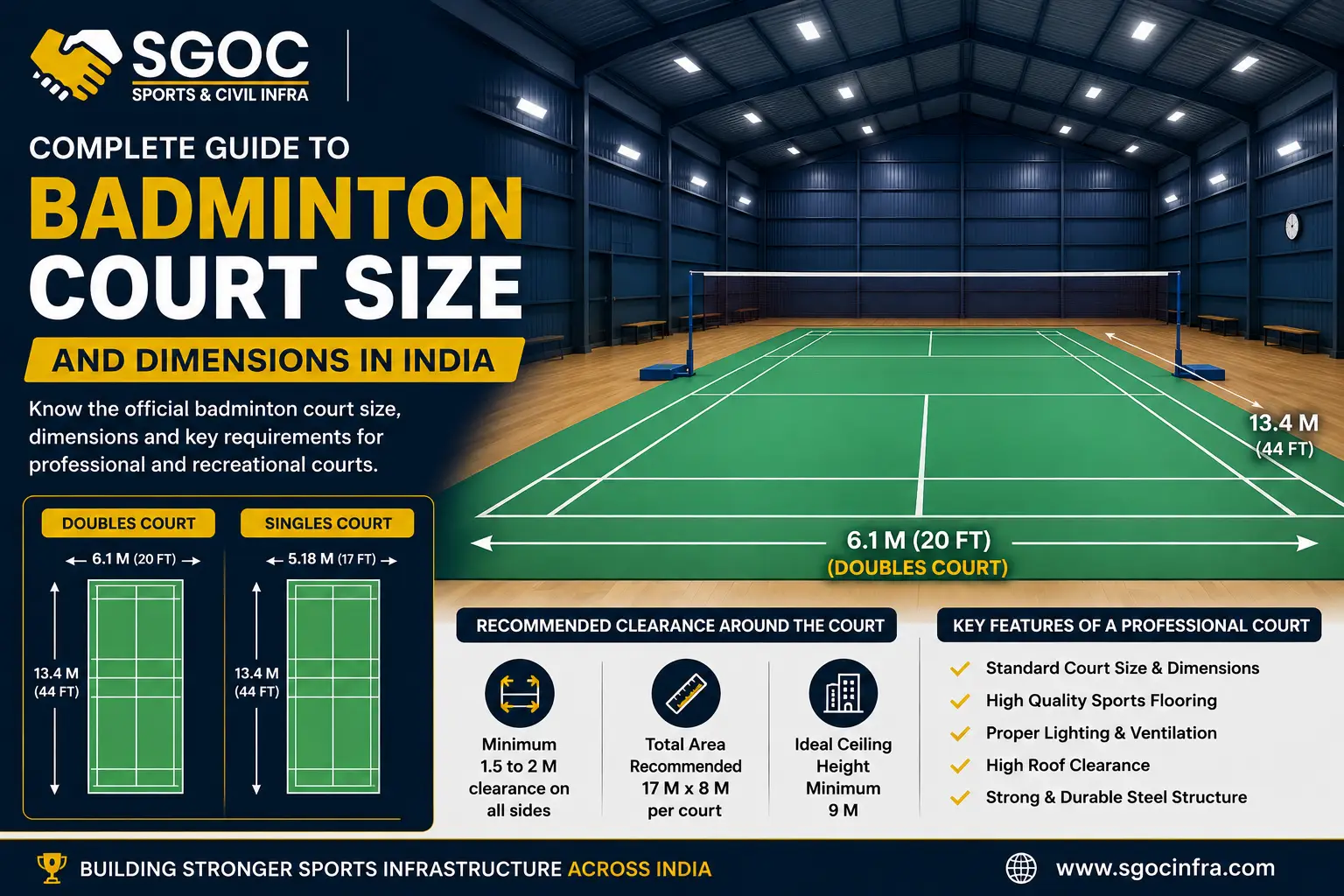
The standard badminton court dimensions are:
- Length: 13.4 meters (44 feet)
- Width for doubles: 6.1 meters (20 feet)
- Width for singles: 5.18 meters (17 feet)
These dimensions are applicable for all professional indoor badminton courts. Whether you are constructing a sports complex, school court, or academy infrastructure, following the official court badminton size is essential.
Badminton Court Size and Dimensions Explained
When discussing badminton court size and dimensions, it is important to understand the different sections marked on the playing surface.
1. Baseline
The baseline marks the back boundary of the badminton court.
2. Sidelines
- Outer sidelines are used for doubles matches.
- Inner sidelines are used for singles matches.
3. Service Lines
The short service line and long service line define the serving area during gameplay.
4. Centre Line
This line divides the service courts into left and right sections.
5. Net Line
The badminton net divides the court equally into two halves.
Understanding the size of the court of badminton helps players, coaches, and facility owners maintain accurate court markings for tournaments and practice sessions.
Singles vs Doubles Court Dimensions
One common confusion people have while learning about badminton court size is the difference between singles and doubles courts.
Singles Court Dimensions
- Length: 13.4 meters
- Width: 5.18 meters
Doubles Court Dimensions
- Length: 13.4 meters
- Width: 6.1 meters
The only major difference is the width of the court. Doubles matches use the full width, while singles matches use the inner sidelines.
Recommended Space Around the Court
Apart from the playing area, additional free space is required around the court for safe movement and professional gameplay.
Experts recommend:
- Minimum 1.5 to 2 meters clearance on all sides
- Extra height clearance for indoor badminton courts
For professional badminton arenas in India, the recommended overall area per court is approximately:
- 17 meters x 8 meters
This ensures enough movement space for players, referees, and spectators.
Ideal Ceiling Height for Indoor Badminton Courts
While discussing the size of the court in badminton, ceiling height is another crucial factor.
According to professional sports infrastructure standards:
- Minimum ceiling height should be around 9 meters
- Professional tournament courts may require 12 meters or more
Low ceilings can affect shuttle movement and reduce playing quality. This is why modern indoor badminton facilities in India prefer high-quality steel structure roofing systems.
Importance of Proper Badminton Court Construction
A correctly designed badminton court improves:
- Player performance
- Safety standards
- Tournament readiness
- Durability of the infrastructure
- Professional appearance
Improper measurements or low-quality construction can lead to uneven gameplay and maintenance issues.
Professional sports infrastructure companies like SGOC Infra specialise in constructing modern indoor sports facilities using durable steel structures, premium roofing systems, and long-lasting sports flooring solutions.
Types of Badminton Court Flooring
The flooring plays a major role in badminton court performance. Different facilities choose flooring based on budget, usage, and competition level.
Wooden Flooring
Wooden badminton courts are commonly used in international tournaments because they provide excellent grip and shock absorption.
Synthetic Flooring
Synthetic PVC flooring is widely used in Indian sports academies and indoor halls due to:
- Easy maintenance
- Durability
- Cost-effectiveness
- Better player comfort
Acrylic Flooring
Acrylic surfaces are used for multipurpose sports courts and training areas.
Choosing the right flooring helps maintain the standard badminton court size and ensures smooth gameplay.
Why Indoor Badminton Courts Are Popular in India
India has seen rapid growth in badminton participation over the last decade. With increasing interest in sports infrastructure development, indoor badminton facilities are being constructed in:
- Schools
- Colleges
- Residential societies
- Corporate campuses
- Sports academies
- Community centres
Indoor courts protect players from weather conditions and allow year-round practice.
Modern steel structure solutions have made badminton arena construction faster, stronger, and more cost-effective across India.
Key Features of a Professional Badminton Court
A professional badminton facility should include:
- Accurate badminton court size and dimensions
- Anti-skid sports flooring
- High roof structure
- Proper LED lighting
- Ventilation systems
- Durable steel construction
- Spectator seating arrangements
- Safety padding and fencing
These features improve player experience and ensure long-term infrastructure quality.
Common Mistakes During Badminton Court Construction
Many people searching for what is badminton court size often overlook other important construction requirements.
Incorrect Court Measurements
Even small errors in dimensions can affect gameplay quality.
Poor Flooring Selection
Low-quality flooring may lead to injuries and faster wear.
Insufficient Height Clearance
Low roofs can interfere with shuttle movement.
Improper Lighting
Bad lighting affects player visibility during matches.
Weak Structural Design
A durable steel structure is essential for long-lasting indoor badminton arenas.
Working with experienced sports infrastructure companies helps avoid these issues.
Growing Demand for Sports Infrastructure in India
The sports industry in India is growing rapidly due to:
- Government sports initiatives
- Increased awareness about fitness
- Rising interest in badminton
- Expansion of private sports academies
- Growth of school sports programs
As a result, demand for professionally designed badminton courts and sports infrastructure solutions has increased significantly.
Companies like SGOC Infra are contributing to this growth by offering customised sports structure solutions for indoor and outdoor sports facilities across India.
How to Choose the Right Sports Infrastructure Partner
Before building a badminton facility, consider the following:
- Experience in sports infrastructure
- Knowledge of official badminton court size
- Quality of steel structures
- Flooring expertise
- Roofing solutions
- Project completion timeline
- After-sales support
A reliable infrastructure partner ensures that your badminton court meets professional standards and delivers long-term performance.
Conclusion
Understanding badminton court size and dimensions is essential for anyone planning to build a professional or recreational badminton facility. From court measurements and flooring to ceiling height and steel structures, every detail contributes to better gameplay and infrastructure durability.
The standard size of the court of badminton includes precise measurements that should always follow international guidelines. Whether you are constructing a sports academy, school court, or indoor arena, proper planning and professional execution are necessary for successful sports infrastructure development.
With the growing popularity of badminton in India, investing in high-quality sports facilities has become more important than ever. Trusted companies like SGOC Infra help create durable, modern, and tournament-ready badminton courts designed for long-term performance and player safety.
FAQs
What is badminton court size?
The standard badminton court size is 13.4 meters in length and 6.1 meters in width for doubles matches.
What is the size of the court in badminton singles?
For singles matches, the badminton court width is 5.18 meters while the length remains 13.4 meters.
Why is proper badminton court size important?
Correct court dimensions ensure fair gameplay, player safety, and compliance with professional standards.
Which flooring is best for badminton courts?
Synthetic PVC and wooden flooring are commonly used for professional badminton courts.
Can badminton courts be built outdoors?
Yes, but indoor badminton courts are preferred in India because they protect players from weather conditions and provide better playing environments.